No. A bill of supply shows no GST, so there is no tax for the buyer to claim as credit. Credit flows only through a valid tax invoice.
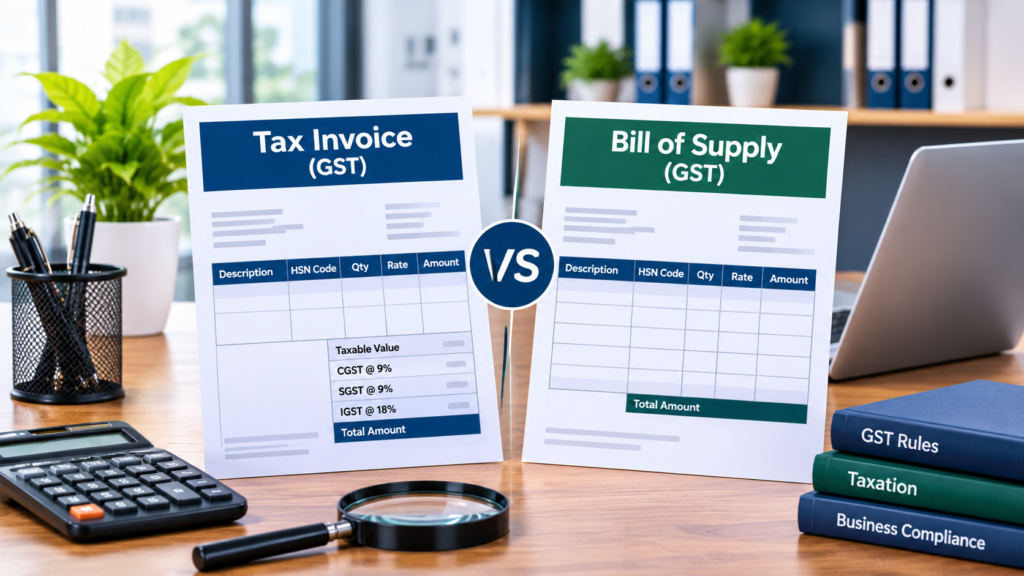
Tax invoice vs bill of supply difference with format is something every GST-registered seller should understand before issuing the next bill. The wrong document can stop your buyer from claiming input tax credit, put a composition dealer in a tight spot, or simply make your records messy at return time. This guide shows which document to issue, what each one must contain and two sample layouts you can copy.
A tax invoice is the document for a taxable supply made by a regular registered dealer. A bill of supply is the document for a composition dealer, or for goods and services that are exempt from GST. The tax invoice vs bill of supply difference with format comes down to one idea: whether GST is charged and shown on the document.
| Point | Tax invoice | Bill of supply |
|---|---|---|
| Legal basis | Section 31 of the CGST Act and Rule 46 | Section 31(3)(c) and Rule 49 |
| Issued by | Regular registered dealer making a taxable supply | Composition dealer, or a supplier of exempt or nil-rated goods or services |
| GST on the document | Shown separately as CGST and SGST, or IGST | No tax is charged or shown |
| Buyer’s input tax credit | Available, if other conditions are met | Not available |
| Special declaration | None | Composition dealers write that they are a composition taxable person not eligible to collect tax on supplies |
| E-invoicing | Applies above the notified turnover limit | Not applicabl |
Issue a tax invoice for every taxable supply of goods or services you make as a regular registered dealer. It is your proof of sale, your proof that GST was charged and the document your buyer uses to claim credit. Our guide to input tax credit under GST explains why the buyer needs it.
Seeing the tax invoice vs bill of supply difference with format through a real sale makes it easier to remember. A trader sells goods worth ₹10,000 at 18% GST. The tax invoice shows a taxable value of ₹10,000, GST of ₹1,800 and a total of ₹11,800. For a sale within the same state, the ₹1,800 splits into CGST and SGST of ₹900 each. For a sale to another state, it appears as IGST. If you need a refresher on the three taxes, see types of GST: CGST, SGST and IGST.
Businesses above the notified turnover limit also have to generate e-invoices for B2B sales, which adds an IRN on top of the normal tax invoice. Our GST e-invoicing guide covers the limit and the process.
You issue a bill of supply in two situations. First, when you are a composition dealer, because you cannot collect tax from customers. Second, when you supply goods or services that are exempt or nil-rated. In both cases no GST appears on the bill, and the buyer cannot take credit. If you are not sure which scheme you are on, read our post on the GST composition scheme first. Choosing the wrong document is one of the most common errors in the tax invoice vs bill of supply difference with format that small traders face. Invoice-cum-bill of supply. If you sell both taxable and exempt items to an unregistered person, the rules let you issue one combined document. It must carry the particulars of both a tax invoice and a bill of supply. For a registered buyer, keep them separate.
Knowing the tax invoice vs bill of supply difference with format means knowing the fields each one needs. Rule 46 lists the particulars for a tax invoice, and Rule 49 does the same for a bill of supply. You can read the rules on the CBIC GST website.
A tax invoice must show:
A bill of supply must show:
Use these layouts as a starting point and adjust them in your billing software.
Sample tax invoice format
| Field | What to write |
|---|---|
| Heading | TAX INVOICE |
| Supplier | Business name, address, GSTIN |
| Invoice no. and date | INV/2026-27/001, DD-MM-YYYY |
| Buyer | Name, address, GSTIN (if registered) |
| Place of supply | State name and code; reverse charge: Yes or No |
| S.No | Description | HSN/SAC | Qty | Rate | Taxable value | CGST | SGST/IGST | Total |
|---|---|---|---|---|---|---|---|---|
| 1 | Item name | 0000 | 10 | ₹1,000 | ₹10,000 | ₹900 | ₹900 | ₹11,800 |
Below the table add taxable value, total GST, invoice total in figures and words, and the authorised signature.
Sample bill of supply format
Notice that there are no tax columns at all, which is the clearest tax invoice vs bill of supply difference with format you can see on paper.
| Field | What to write |
|---|---|
| Heading | BILL OF SUPPLY |
| Declaration (composition dealers) | Composition taxable person, not eligible to collect tax on supplies |
| Supplier | Business name, address, GSTIN |
| Bill no. and date | BOS/2026-27/001, DD-MM-YYYY |
| Buyer | Name, address, GSTIN (if registered) |
| S.No | Description | Qty | Rate | Value |
|---|---|---|---|---|
| 1 | Item name | 10 | ₹1,000 | ₹10,000 |
Below the table add the total value and the authorised signature. Notice that there are no tax columns at all.
Most of these slips come from not knowing the tax invoice vs bill of supply difference with format before the billing software is set up. Fixing the template once saves hours of correction later.
Small traders rely on Complete Tax because we handle GST registration, returns, invoicing and accounting with real hands-on experience, so they do not have to run between different consultants for every task. which document to issue, when to issue it and why the tax invoice vs bill of supply difference with format matters for your buyer’s input tax credit. Our team keeps the communication plain and jargon-free, which means you always know which document to issue, when to issue it and why it matters for your buyer’s input tax credit. We also look at your billing setup as a whole, checking that your invoice format, HSN or SAC codes and return data match, so small mistakes do not turn into notices later. Based in Ganj Basoda, we serve clients in every state through online support, which keeps your GST work on track wherever your business operates and lets you focus on selling instead of paperwork.
A tax invoice charges and shows GST and lets your buyer claim input tax credit, while a bill of supply shows no tax and is used by composition dealers and for exempt supplies. Both carry supplier, buyer, serial number and date, but a tax invoice adds HSN or SAC codes, tax rates and tax amounts.
No. A composition dealer cannot collect tax from customers, so every sale needs a bill of supply that states the dealer is a composition taxable person not eligible to collect tax on supplies.
Only when the buyer is unregistered. In that case a single invoice-cum-bill of supply is allowed, and it must carry the particulars of both documents. For a registered buyer, issue a tax invoice for taxable items and a bill of supply for exempt items.
No. A bill of supply shows no GST, so there is no tax for the buyer to claim as credit. Credit flows only through a valid tax invoice.
For goods, the invoice is generally issued at or before removal or delivery. For services, it is generally issued within 30 days of the supply, with a longer window for certain financial services. Check the current invoicing rules for your exact case.
If you want the tax invoice vs bill of supply difference with format applied correctly from day one, Complete Tax handles your GST invoicing end to end. You receive:
Call: +91-7898701724 / +91-7898701725
Write to: completetax2020@gmail.com
Visit: Near Indane Gas Agency, Mill Road, Ganj Basoda, Near Bhopal (M.P.) – 464221
Send us a sample of your current bill and we will tell you whether it follows the right format. You can also start with our GST registration service or our accounting service.









WhatsApp us