
You can pay the related tax in the remaining instalments of the year. Interest for earlier dates does not apply to that unforeseen income.
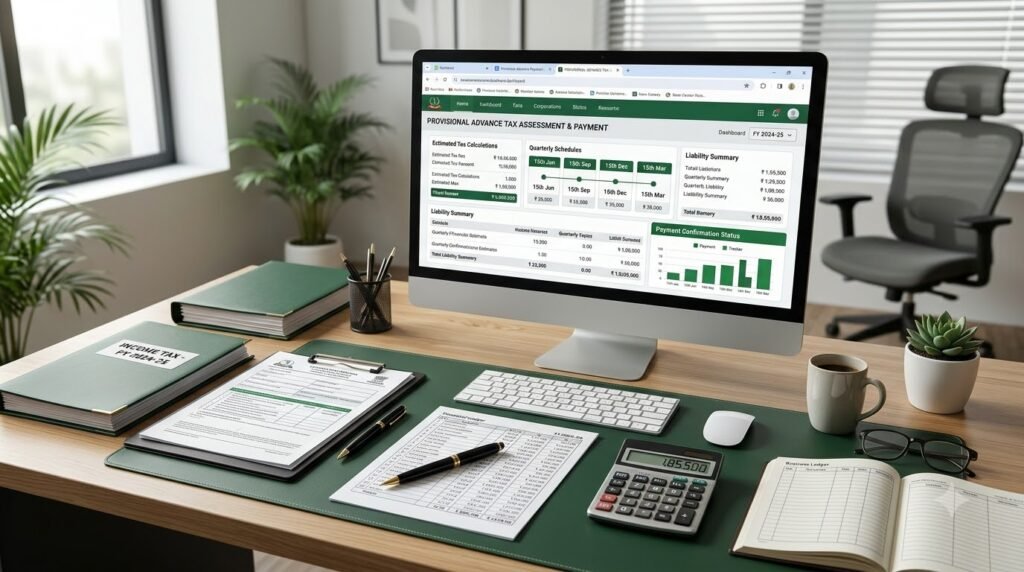
Advance tax payment means paying your income tax in instalments during the year in which you earn the income, instead of settling everything when you file your return. If your estimated tax bill after TDS and TCS is ₹10,000 or more, the law expects you to pay in advance. Salaried people with side income, freelancers, shop owners, consultants and investors with capital gains all fall into this net more often than they realise.
This guide covers who must pay, the due dates for tax year 2026-27, a worked calculation, the online payment route, and what happens if you miss an instalment. It is written by the tax team at Complete Tax in Ganj Basoda, who help individuals and small businesses plan these payments every quarter.
You are generally required to pay if your net tax liability for the year, after reducing TDS and TCS, is ₹10,000 or more. That covers a wide range of people:
Resident senior citizens aged 60 and above who have no business or professional income are exempt. If your tax after TDS stays under ₹10,000, you simply pay any balance when you file your return.
Income earned from 1 April 2026 is governed by the Income-tax Act, 2025, and the year is now called the “tax year” instead of the financial year and assessment year pairing. For advance tax, the practical position is reassuring: the ₹10,000 threshold and the four-instalment structure continue as before. The instalment due on 15 March 2026 belonged to the old year and stayed under the 1961 Act, so the new rules apply to the schedule below.
Regular taxpayers pay in four cumulative steps:
| Due date | Cumulative amount to be paid |
|---|---|
| 15 June 2026 | 15% of estimated tax |
| 15 September 2026 | 45% of estimated tax |
| 15 December 2026 | 75% of estimated tax |
| 15 March 2027 | 100% of estimated tax |
As of today, the next instalment you need to plan for is the one due on 15 December 2026. Taxpayers under the presumptive scheme, such as small businesses and professionals who declare income on a presumptive basis, can pay the entire amount in a single instalment by 15 March. Any tax paid up to 31 March 2027 is treated as advance tax for the year, but paying after an instalment date can still attract interest.
You do not need complicated software. A simple estimate is enough if you follow a clear order.
Suppose a freelancer estimates a remaining tax liability of ₹2,00,000 for the year.
| Due date | Cumulative target | Pay in this instalment |
|---|---|---|
| 15 June | ₹30,000 | ₹30,000 |
| 15 September | ₹90,000 | ₹60,000 |
| 15 December | ₹1,50,000 | ₹60,000 |
| 15 March | ₹2,00,000 | ₹50,000 |
If income rises mid-year, revise the estimate and adjust the next instalments rather than waiting for the return.
Capital gains and dividends. These are hard to predict. If you earn them after an instalment date has passed, you can include the related tax in the remaining instalments of the year without facing interest for the earlier dates.
Presumptive taxpayers. Small business owners and professionals on the presumptive scheme pay once, by 15 March.
Irregular income. Seasonal businesses and project-based consultants should recheck the estimate every quarter, since a single large invoice can change the picture.
Online payment takes a few minutes through the e-filing portal:
Keep the challan. You will need its details to claim credit when you file your return, and the Income Tax Department website is where you can verify the payment later. If you are comfortable filing yourself, our walkthrough on how to file ITR online step by step shows where these payments are entered.
Missing a due date does not cancel your obligation. Interest is charged at 1% per month on the shortfall, calculated separately for each instalment you underpaid. A separate interest charge can apply if your total advance tax for the year falls well short of your final liability. These charges are not deductible, so they are a pure cost that careful planning avoids. The exact computation depends on the dates and amounts involved, which is why many taxpayers prefer to have a professional check the numbers before filing.
Owners choose Complete Tax because tax, registration and accounting support sit under one roof. You do not have to explain your business to three different advisors. Our team tracks notifications from the GST Council and the CBIC, explains changes in plain language and keeps your records ready for return filing. Fees stay transparent, and you always know who is handling your file.
When you hand your invoicing compliance to Complete Tax, you get structured, hands-on support:
Contact no.: +91-7898701724 / +91-7898701725
Email: completetax2020@gmail.com
Address: Near Indane Gas Agency, Mill Road, Ganj Basoda, Near Bhopal (M.P.) – 464221
Get your invoicing in order before the next portal rejection, and let experts keep your compliance on track.
Any taxpayer whose estimated tax after TDS and TCS is ₹10,000 or more for the year. This includes freelancers, business owners and salaried people with other income. Resident senior citizens without business income are exempt.
The cumulative due dates are 15 June (15%), 15 September (45%), 15 December (75%) and 15 March (100%).
Yes. Taxpayers under the presumptive scheme can pay the whole amount in a single instalment on or before 15 March.
You can pay the related tax in the remaining instalments of the year. Interest for earlier dates does not apply to that unforeseen income.
Yes. Interest generally runs at 1% per month on the shortfall for each instalment, and additional interest can apply if your total advance tax falls well short of your final liability.








WhatsApp us