
If your aggregate turnover is ₹10 crore or more, the portal rejects invoices, credit notes and debit notes older than 30 days and does not issue an IRN.
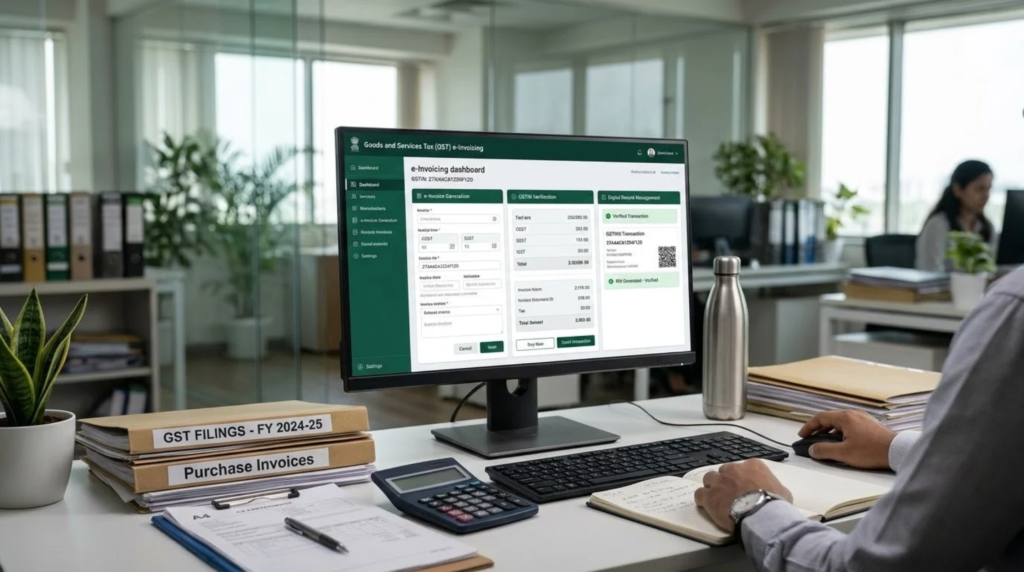
GST e-invoicing is the system in which a business registers its B2B invoice on a government portal before handing it to the buyer. The portal checks the invoice, issues a unique reference number and a signed QR code, and only then does the document count as a valid tax invoice. If your turnover has crossed the prescribed limit, skipping this step is not a minor paperwork slip. It can leave your customer unable to claim input tax credit and put your own compliance record at risk.
This guide explains who has to follow GST e-invoicing, which businesses are exempt, how the process works, what the 30-day reporting rule means and which mistakes owners make most often. The practical pointers come from the team at Complete Tax, who handle GST work for businesses in Ganj Basoda, Bhopal and across Madhya Pradesh.
Despite the name, GST e-invoicing does not create a new kind of invoice. You still raise invoices in your usual billing or accounting software. The difference is that, for covered transactions, the invoice data is sent to the government’s Invoice Registration Portal (IRP), which authenticates it in real time.
Once the invoice passes validation, the portal returns three things:
The authenticated data then flows on to the GST portal and the e-way bill system. That means your sales details reach the tax system at the moment of invoicing rather than weeks later when returns are filed, which is the whole point of the system.
The current e-invoice turnover limit is ₹5 crore. A business must generate e-invoices if its aggregate annual turnover exceeded ₹5 crore in any financial year from 2017-18 onwards. Three details catch people out:
If you are a growing business sitting just under the limit, plan the move before you cross it. Setting up billing formats, mapping HSN codes and training your accounts staff takes weeks, not days. Our guide to the types of GST is a useful refresher on how CGST, SGST and IGST appear on these invoices.
Even above the limit, some categories are exempt from the mandate. These include SEZ units, banks and NBFCs, insurers, goods transport agencies, passenger transport services and multiplex cinema admission services. Exemption depends on the nature of your business, so confirm your category against the latest notification instead of assuming it applies.
The flow looks technical on paper but becomes routine within a few billing cycles.
An invoice that never receives an IRN is not treated as a valid tax invoice for a covered taxpayer. If you cancel an e-invoice, it must be done within 24 hours of IRN generation. After that window, the correction route is a credit note or debit note.
The IRP rejects invoices with missing or inconsistent data, so keep these items accurate:
A wrong GSTIN or HSN code is the single most common reason for rejection. Businesses that registered recently should double-check these details from their GST registration certificate before configuring their software.
From 1 April 2025, taxpayers with aggregate annual turnover of ₹10 crore or more cannot report an invoice, credit note or debit note to the IRP once it is more than 30 days old. The portal simply rejects late documents and no IRN is issued.
For example, an invoice dated 1 October 2026 should be reported by 30 October 2026. Teams that wait for month-end accounting close are the ones who get caught. Taxpayers between ₹5 crore and ₹10 crore are not currently under this restriction, but reporting invoices within a few days is a sound habit for them as well.
Compliance is the headline, but there are real operating gains. Returns get pre-filled from invoice data, so reconciliation errors drop. Your buyers see your invoices faster in their records, which supports smoother credit claims and fewer payment disputes. And a clean, system-generated invoice trail makes audits and bank due diligence less painful. If your finance team is stretched, our article on outsourcing accounting services for a small business shows how to hand over the routine work without losing control.
Owners choose Complete Tax because tax, registration and accounting support sit under one roof. You do not have to explain your business to three different advisors. Our team tracks notifications from the GST Council and the CBIC, explains changes in plain language and keeps your records ready for return filing. Fees stay transparent, and you always know who is handling your file.
When you hand your invoicing compliance to Complete Tax, you get structured, hands-on support:
Contact no.: +91-7898701724 / +91-7898701725
Email: completetax2020@gmail.com
Address: Near Indane Gas Agency, Mill Road, Ganj Basoda, Near Bhopal (M.P.) – 464221
Get your invoicing in order before the next portal rejection, and let experts keep your compliance on track.
No. It applies to businesses whose aggregate turnover exceeded ₹5 crore in any financial year from 2017-18 onwards, and only for covered transactions such as B2B supplies, supplies to government entities and exports. Exempt categories are not covered.
The IRN is a 64-character code generated by the Invoice Registration Portal for each e-invoice. Without it, a covered taxpayer’s invoice is not a valid tax invoice, which can affect the buyer’s credit claim.
Under the current IRN system, B2C invoices are not reported to the portal. The mandate focuses on B2B, B2G and export invoices.
If your aggregate turnover is ₹10 crore or more, the portal rejects invoices, credit notes and debit notes older than 30 days and does not issue an IRN.
You cannot edit it. You can cancel it within 24 hours of IRN generation. After that, you correct it by issuing a credit note or debit note.







WhatsApp us