
The NGO loses its tax-exempt status and must reapply as a fresh applicant, which can disrupt donor benefits.
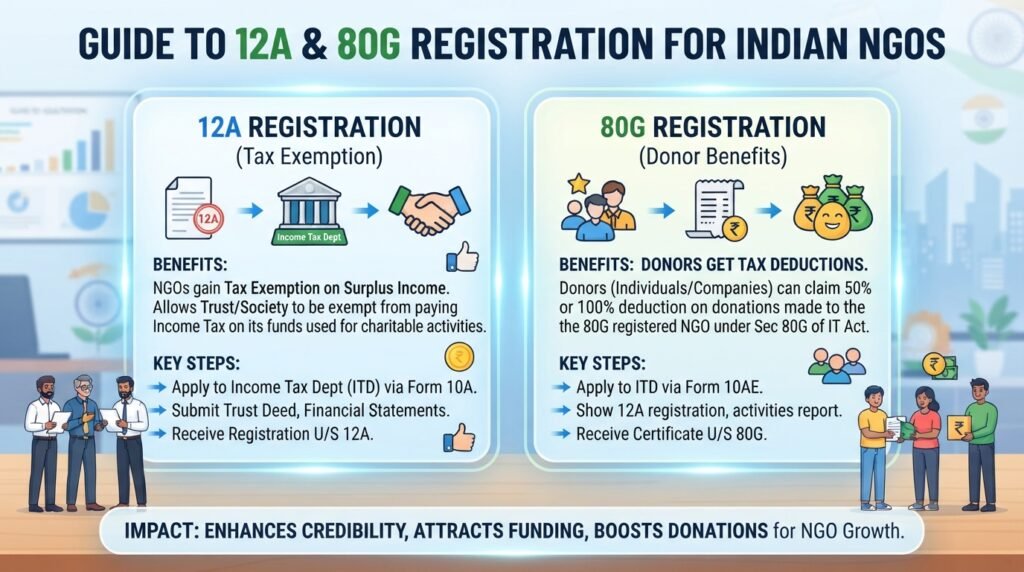
If you run or plan to start an NGO, trust, or Section 8 company in India, getting 12A and 80G registration is essential — not just for tax exemption, but also for building donor trust and accessing government/CSR funding. Here’s a complete, up-to-date guide.
12A registration under the Income Tax Act allows an NGO/trust to claim exemption from income tax on its surplus income, provided that income is used for charitable purposes. Without 12A registration, an NGO’s income is taxed just like any other entity.
80G registration allows donors to claim a tax deduction on donations made to your NGO. This is a major incentive for individuals and companies to donate — most serious donors will ask whether your NGO has valid 80G certification before contributing.
Recent years have brought stricter compliance requirements:
Complete Tax assists trusts, societies, and Section 8 companies across Madhya Pradesh with end-to-end 12A and 80G registration and renewal — from document preparation to portal filing and follow-up.
Visit our 12A & 80G Registration page or contact us for a free eligibility check.
Yes, new NGOs can apply for provisional registration, valid for 3 years, before applying for final registration.
No, but without it, donors cannot claim tax deductions, which significantly reduces donation inflow.
Typically every 5 years, as per the current renewal framework.
The NGO loses its tax-exempt status and must reapply as a fresh applicant, which can disrupt donor benefits.


WhatsApp us